Flooded Basement Cleanup Stockbridge, GA: Safe Water Removal and Complete Drying
Water in your basement or crawl space? Stay out until electrical hazards are handled, and call (470) 821-0095. Emergency calls are answered right away, and a crew can start removing water as quickly as possible.
Or tell us what happened
Send the details and we will get back to you fast. For basement water, call now instead of waiting.
Request received
Thanks. We will call you back shortly. If water is still coming in, call (470) 821-0095 right now.
Response
Flooded Basement and Crawl Space Cleanup in Stockbridge, Done Right
Safe water removal, soaked-material removal and full drying for basements and crawl spaces in Stockbridge, GA.
Cleaning up a flooded basement comes down to five steps, in order: make sure it is safe to enter, stop the water source, remove the standing water in stages, throw away soaked porous materials, and dry everything within 24 to 48 hours so mold can’t take hold.
If you need flooded basement cleanup Stockbridge GA homeowners can call at any hour, we handle all five. Many Stockbridge homes, including newer communities around Eagles Landing, are built over basements, and others sit on crawl spaces. Both flood the same way: heavy rain saturates the clay soil, a sump pump stops, a pipe fails, or storm water finds a low door or window.
While you wait, don’t walk into standing water if outlets, cords, or the electrical panel might be wet, and turn off power only if you can reach the panel without stepping in water. Shut off the water at the main valve if a pipe is the source, move valuables upward, and photograph the damage before anything is moved.
Is It Safe to Enter a Flooded Basement?
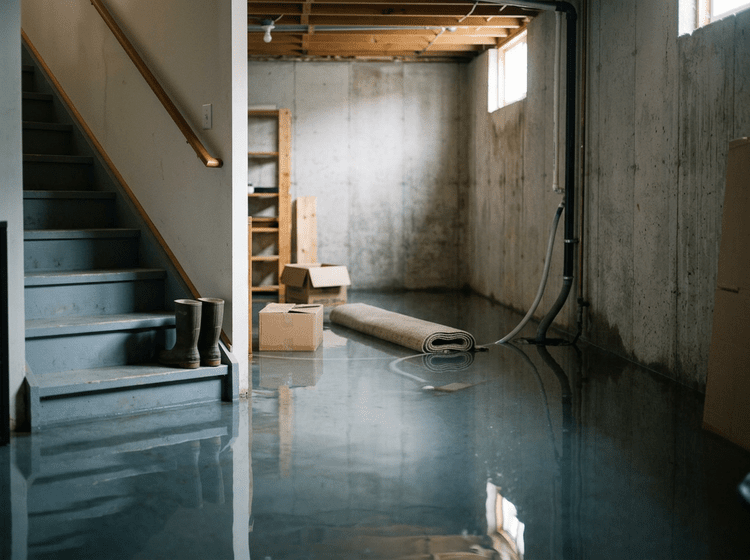
Not always. Three hazards decide it: electricity, contaminated water, and the structure itself.
| Hazard | What to do |
|---|---|
| Electricity | Standing water near outlets, cords, appliances, or the panel is a shock risk. Don’t enter. If the panel is in the flooded area or you aren’t sure it’s safe, call a licensed electrician or your electric utility |
| Contaminated water | Water from a sewer backup or storm runoff is contaminated. Don’t touch it, and see Sewage Cleanup |
| Deep or rising water | Stay out. Deep or fast-rising water isn’t safe to wade into |
| Gas odor | Leave the house and call the gas utility |
| Weakened structure | Widening cracks or bowing walls mean stay out and call us |
A small amount of clean water from a known source, like a split washing machine hose, is a different case once the electrical situation has been checked.
Emergency: What to Do First When Your Basement Floods
- Get everyone out of the water and keep children and pets away.
- Deal with electricity. Cut power to the basement at the panel only if you can reach it without stepping in water. Otherwise leave it alone and call.
- Stop the source. Shut off the main water valve if a pipe or fixture is leaking.
- Photograph and video the damage and the water line before anything is moved.
- Call (470) 821-0095.
- Lift valuables and furniture off wet floors if you can do it safely.
- Skip the household vacuum, and don’t run fans through the area if mold is already visible, because moving air can spread spores.
Don’t try to pump the basement dry all at once. If the ground outside is still soaked, removing all the water quickly can let the weight of saturated soil push on the walls and floor, which is why we pump in stages.
Crawl Space Water Removal Stockbridge Homeowners Shouldn’t Put Off
Crawl spaces are easy to ignore because nobody goes in them, and that is exactly why water sits there. A wet crawl space rots wood, soaks insulation, feeds mold, and sends damp, musty air up into the rooms above.
Water in Crawl Space: Where It Comes From and What It Damages
Water in crawl space areas usually arrives one of four ways: groundwater pushed through the foundation by saturated clay soil, a plumbing or water heater leak, an overflowing HVAC condensate line, or humid outside air entering a vented crawl space and condensing on cool surfaces. The damage is slow, which is why it goes unnoticed. Floor joists and subfloor wood weaken, insulation sags and holds moisture, metal rusts, and mold grows on the framing.
Here is what we do. We shut off any plumbing source, remove standing water with pumps, take out wet insulation and ruined material, dry the space with air movers and dehumidifiers, and clean and treat the framing. We also tell you what we find. If it points to a drainage problem, or you want a vapor barrier or full encapsulation so it doesn’t happen again, that is a separate job for a crawl space or waterproofing specialist, and we will tell you what to ask for.
Never crawl into a space with standing water near wiring. Call us first.
Sump Pump Failure Flooding: Why It Happens and What to Do
Sump pumps tend to fail at the worst moment, because the storm that floods your yard is often the storm that knocks out your power. The most common causes are:
- Power loss: an outage, a tripped breaker or GFCI, or a loose plug
- A stuck float switch that never tells the pump to start
- A clogged intake or discharge line, or a frozen discharge line outside
- A failed check valve that lets pumped water fall back into the pit
- An old pump that still runs but has lost most of its capacity
- Overwhelmed drainage, when rain, gutters, or grading send more water than a working pump can move
If it is safe to reach the pit, check that the pump is plugged in, the GFCI hasn’t tripped, and the float moves freely. If water is already standing near electrical equipment, don’t go in. Call us.
Getting the pump running again is only half the job. The water already in the basement still has to come out, and the structure still has to dry, which is where we come in.
How We Remove Water and Dry a Flooded Basement
Basement Water Removal in Stages
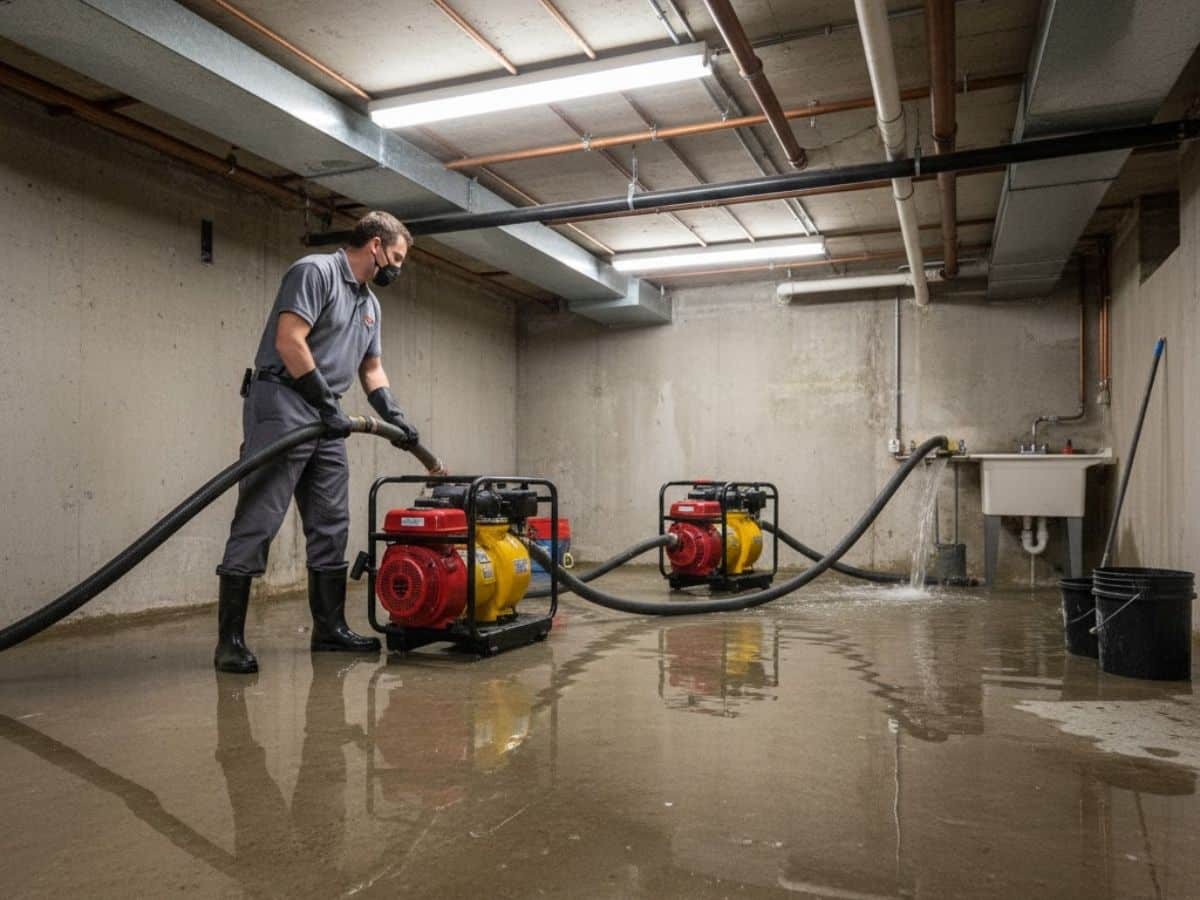
Our basement water removal uses submersible pumps and extractors, working from the lowest point outward. If the ground outside is still saturated, we remove the water in stages and watch the level between stages, because the weight of saturated soil can push walls inward when the water inside is drained too fast. FEMA warns about exactly this.
Removing Soaked Materials
Carpet, pad, the lower section of wet drywall, and wet insulation come out, because they hold water and grow mold behind the surface. We also pull stored cardboard and anything porous that can’t dry quickly. If the water came from sewage or storm runoff, everything porous that touched it is treated as contaminated.
Wet Basement Drying: Moisture Mapping to Dry Standard
Wet basement drying uses air movers and dehumidifiers matched to the room. We map moisture with meters and thermal imaging so we know where the water went, including inside walls. Concrete and block hold moisture, so basements can take several days to dry. Typical professional drying runs about three to five days, and severe cases take longer. If mold is already visible, we contain the area before moving air through it. We keep taking readings until the structure reaches its dry standard.
Cleaning, Disinfection, and Mold Checks
Surfaces are cleaned and treated where needed, and we check hidden spots for mold. If we find it, we show you and explain the next steps. See Mold Remediation.
What Gets Removed and What Can Be Saved in a Flooded Basement
These are typical outcomes. Moisture readings and the condition of each item make the final call.
| Material or item | Typical outcome |
|---|---|
| Carpet and pad after clean water, caught fast | Carpet often dried; pad commonly replaced |
| Carpet and pad after sewage or storm water | Removed |
| Drywall and insulation that stayed wet or touched contaminated water | Removed |
| Concrete floors and block walls | Cleaned and dried |
| Wood framing | Dried and treated when sound |
| Cardboard boxes and stored paper | Usually discarded |
| Furniture | Case by case; soaked upholstered pieces are often discarded |
| Appliances and electronics | Not safe to use until a qualified technician checks them |
Basement Flooding and Your Insurance
Call (470) 821-0095 and we’ll walk you through what to document and what to expect.
Call now, we answer 24/7
Every minute counts with water damage. Our Stockbridge crew is ready to roll.
Call (470) 821-0095Preventing the Next Flood: Sump Pump, Grading, and Gutters
We can’t waterproof a foundation, but we can tell you what we saw. Most repeat basement floods trace back to a few fixable things:
- A battery backup for the sump pump. Most sump pump failure flooding happens during the same storm that cuts the power.
- A yearly test. Pour water into the pit each spring to make sure the float starts the pump, and clear silt and debris from the pit.
- A discharge line that carries water well away from the foundation.
- Clean gutters and extended downspouts so roof water doesn’t pool beside the walls.
- Grading that slopes away from the house. A commonly cited guideline is about 6 inches of fall over the first 10 feet.
- A backwater valve, if sewer backup has ever reached your basement. Ask a plumber.
- Sealed foundation cracks, which a foundation or waterproofing specialist can assess.
For drainage, grading, French drains, or waterproofing, a qualified specialist is the right call.
Below-Grade Water in Homes, Apartments, and Commercial Properties
We respond to houses, townhomes, apartments, offices, and retail spaces with basements, lower levels, or crawl spaces. Property managers can call the same number for priority response, with written documentation for each job.
Flooded Basement FAQs
How do you clean up a flooded basement?
Make sure it is safe to enter, stop the water source, remove the standing water in stages, throw away soaked porous materials such as carpet, pad, and wet drywall, and dry everything completely within 24 to 48 hours. Then check for hidden mold. Call (470) 821-0095 if the water is deep, contaminated, or near electrical equipment.
Is it safe to go into a flooded basement?
Not if water is touching outlets, cords, appliances, or the electrical panel, and not if the water is deep, rising, or contaminated by sewage or storm runoff. If you can’t tell, stay out and call.
Should I pump all the water out at once?
Not if the ground outside is still saturated. Draining everything quickly can let the pressure of wet soil push on the walls, so water is removed in stages while the level is watched.
How long does it take to dry a basement after a flood?
Typical professional drying takes about three to five days, and severe floods or heavy concrete and block take longer. We stop only when moisture readings show the structure is dry.
Can I use a wet/dry vacuum?
For a small amount of clean water, once the electrical situation is safe. Never use a household vacuum on water, never run electrical equipment while standing in water, and don’t use a vacuum on sewage.
How soon does mold start after a basement flood?
Mold can begin growing on wet materials within 24 to 48 hours, which is why drying starts as soon as the water is out.
What if the crawl space has standing water?
Don’t go in if wiring is nearby or the water might be contaminated. Call us. We remove the water, take out wet insulation, dry the space, and tell you what we find.
Why did my sump pump fail?
The usual causes are power loss, a stuck float switch, a clogged intake or discharge line, a failed check valve, an old pump that has lost capacity, or more water than the pump can move. A battery backup covers the most common one.
Will my basement flood again?
It can, if the cause isn’t fixed. Fixing the pump, the discharge route, the gutters, and the grading together does the most good. See the prevention section above.
Does insurance cover a flooded basement?
Call (470) 821-0095 and we’ll walk you through what to document.
Basement Water Won't Wait. Call Now.
Basement and crawl space water removal Stockbridge homeowners can start today: call (470) 821-0095. Emergency calls are answered right away.